Vasudeva
The Glass Bead GameVasudeva is the court Brahman whose quiet intervention saves the young Dasa from a stepmother determined to supplant him as heir. He arranges Dasa’s removal from the palace into the care of a trusted herdsman, setting in motion the years of pastoral life that separate the prince from his birthright. Vasudeva later receives the herdsmen’s offerings at a festival without recognizing Dasa, and is dead by the time the prince returns to the capital. His role is brief but decisive: he preserves Dasa’s life while leaving the boy’s identity and future in the hands of time.
Position at Court and Dasa’s Disappearance
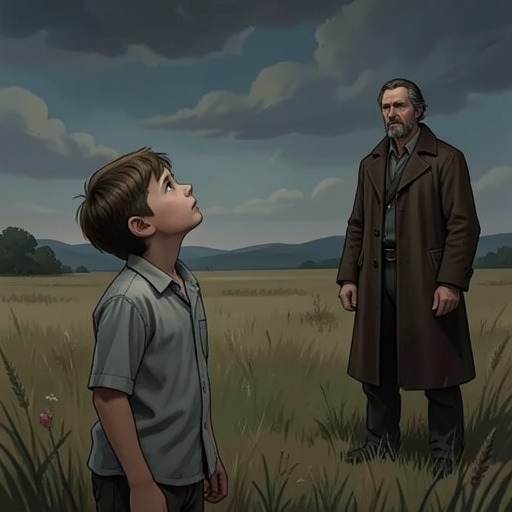
In the embedded Indian tale, Vasudeva serves Ravana as a Brahman responsible for sacrifices. When he learns that Ravana’s second wife intends to remove the firstborn Dasa and clear the way for her own son Nala, Vasudeva watches over the boy until he can put him beyond his stepmother’s reach. His protection is practical rather than public: he confides in a herdsman he has known for years as friendly and reliable, and the two arrange Dasa’s disappearance without letting the court discover the plan.
The herdsman takes Dasa into the hills with the royal herd, where the boy joins the cowherds and gradually grows accustomed to a life far removed from the palace. Dasa does not entirely forget his former home, but it recedes until it seems almost dreamlike. Vasudeva’s intervention therefore protects the child without preserving his immediate claim to power; the prince survives, while his place in the succession becomes hidden even from himself.
The Festival and the Unrecognized Prince
When the herdsmen later bring butter to the palace for festival sacrifices, Vasudeva receives the offering in his capacity as the Brahman in charge of the rites. Dasa is among the young men delivering it, but Vasudeva does not recognize him. The encounter places protector and protected in the same ceremonial setting without restoring their earlier connection: the court Brahman receives the offering, while Dasa joins the crowds as a herdsman and watches Nala celebrated as the young ruler.
Dasa is absorbed by the festival’s spectacle and does not recall that he is the firstborn or that Nala has taken the position that should have been his. He dislikes Nala, but the thought of his own inheritance does not occur to him. The scene underscores the cost and the success of Vasudeva’s concealment: Dasa has been kept safe, yet his identity and political claim remain beyond his awareness.
Death and the Return to the Capital
By the time Dasa is restored as prince and approaches the capital, Vasudeva has recently died. The Brahmans who come out to welcome Dasa are led by Vasudeva’s successor, linking the prince’s return to the court’s continuing religious institution even though the man who first protected him is absent. They hail Dasa, sing hymns, and lead him into the palace, where sacrificial fires have been prepared and the city celebrates his arrival.
Vasudeva’s story thus closes without a reunion or a personal reward. His earlier act makes Dasa’s survival possible, but he does not live to witness the restoration that follows. The succession of Brahmans at the capital marks both continuity and loss: the office remains, its former holder is gone, and the child once removed from the palace returns as ruler.